
 Episode 6
· 38:12
These are so much fun for me. To think that I get to take the thing that I'm super passionate about, marry it to a bunch of people that I know that have a problem, and then connect them with a bunch of people that I know that have solutions to that problem. The world is great, TJ.
TJ:Man, in today's world, we have so much opportunity to really do what we love to do and and what we're passionate about, that's what's really cool.
Roger:And for me, man, I'm telling you, like, it's one thing to bring guests onto a program and have them share their expertise and, you know, dazzle the guests with whatever they they can come up with. But when it's somebody that you personally enjoy, like, talking to, like, I get to talk to my friend and share my friend with all the other people who get to meet get to meet this guy. So ladies and gentlemen, let me introduce you to TJ Bencho. But, TJ, before before we get into any of that, I gotta lay out the premise of the show for you and for all the stewards out there just in case they're joining us for the first time.
TJ:I love it. Before you do that, I just wanna say I get to do something I'm really passionate about. I see hang out with you and drink a real drink out of a really small cup.
Roger:An absurdly small cup. Makes you look like a behemoth. Now that's the best. Do. Not caring.
Roger:You you look like, Wemby. He's a seven six with your little coffee mug in your hand. It's hilarious. But yes. Yes.
Roger:And and but, like and we'll we'll talk at the end about, like, why our relationship is special and and some of the things that go into why I'm so excited to speak to you personally today. But before we get into all of that, one of the things that I wanna make clear to the listeners and the watchers of the program is the capital shift is about an entire process that a person has to go through, and some of it is a shift in your thought process behind how you're going to change your accumulation strategy to a deployment strategy where you actually can take the money that you've been squirreling away and turn it into something that actually gonna work for you. But even more importantly, in order for you to be able to do that successfully, what we've seen time and time and time again, TJ Bencho, is is you gotta change the way you think. Right? So behind you, you'll see a series of or behind me, you see a series of doors.
Roger:The idea behind the program is that you have to go through a series of doors and evolve yourself both from an investment perspective as well as in an identity perspective in order to be here. So TJ Buncho, welcome to the Capital Shift program, my brother.
TJ:Thanks, Raj. I'm so honored, man. I I I can't tell you how much I appreciate being here, how excited I am. We've grown such a amazing relationship over the past two to three years
Roger:Yeah.
TJ:And, with Melissa also. For sure. Even maybe with one of your family members that I've never actually met.
Roger:Yeah. But We're saving that for the bonus content. So for the paid members, they're gonna get to hear that story.
TJ:But this is this is really this is really exciting for me. So I appreciate it, Raj. Big time.
Roger:So, let's lay it out for folks. What's TJ do? What's Steel Point Capital all about? What's the claim to fame, and what's sort of maybe your value proposition for people who might be, getting into this for the first time?
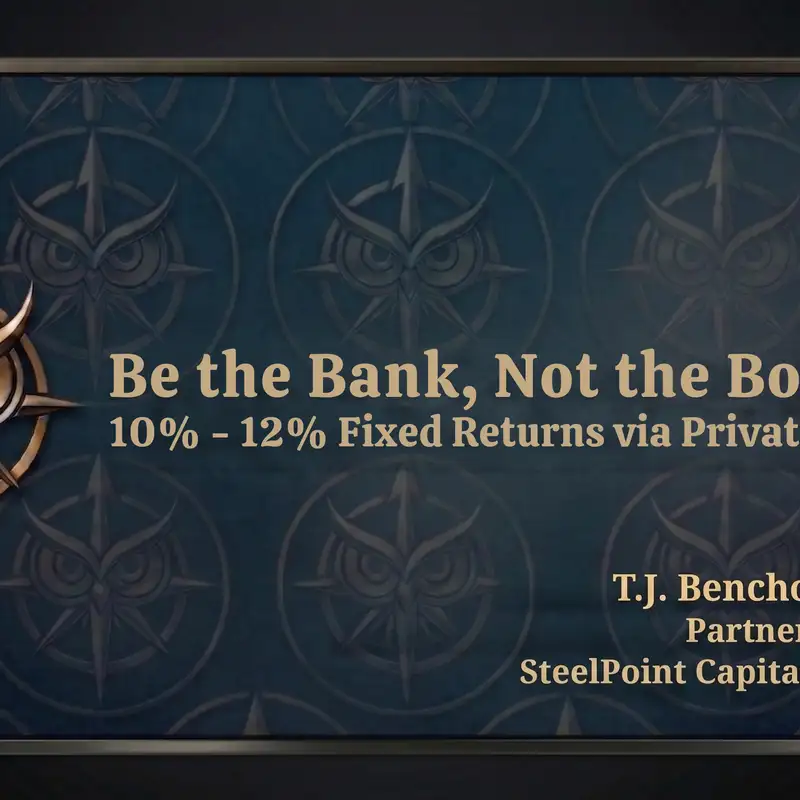
TJ:I like it. Get straight to the point on that. So it's StealPoint Capital. We give people the opportunity to invest with us and earn between a 10% to 12% fixed return on your money with interest paid monthly. So, we do that through a five zero six c SEC regulated fund, and the returns are based off the amount you invest.
TJ:Mhmm. They don't change. It's a debt fund. It's not an equity fund, so you don't have a preferred return plus, and and and there's the variations there. There's there's benefits to the equity fund.
TJ:There's benefits to the debt fund. So a lot of people who invest with us, they're active real estate investors and invest with us or they invest in equity funds market and invest with us. So, you know, it just depends on each individual's strategy why they do it and how they do it, but but it varies. We then use that money to provide short term lending to real estate investors on a six month term and and it's all asset backed. When we lend it, we place a first lien position on the asset we lend on.
TJ:We have the borrower sign a deed in lieu of foreclosure, and then we also thoroughly underwrite the deals we lend on. We're active real estate investors ourselves. So we're uniquely positioned, as lenders that if someone were to default, which we've never had anyone default in the six plus years we've been doing this, But if someone were to default, we could take that asset and make it functional and make us money anyways.
Roger:Right. Yep. Okay. So I'm new to real estate investing. There's a lot of stewards that are early on in their investment development.
Roger:So let's try to explain what you just said in very eloquent terms in the most basic language you can come up with. So Okay. I've got money
TJ:Yep.
Roger:And I'm trying to figure out what to do with my money.
TJ:Yep.
Roger:Right? And so you're telling me that I'll give you my money and then you're gonna pay me money back how frequently?
TJ:We could pay you your money back every month and interest every month or we could do quarterly, biannually, or we could have the interest compound annually and paid out at the end of the term so you could take advantage of the power of compounding interest.
Roger:Okay. When I was a kid, my dad went to the loan shark, and he's like, you wouldn't do this ordinarily. You'd just go to a bank and get a loan. But sometimes the terms aren't so favorable for the person needing to, acquire that money or maybe their credit isn't good enough or, you know, a lot of reasons.
TJ:Yes.
Roger:Is it hot? So, like, why isn't it risky? Why isn't why isn't it this, you know, the back alley, like, oh my god. Is is all this gonna work out okay? Like, how have we evolved as an asset class to sort of for folks who maybe have heard from their moms and dads and grandmas and grandpas like, oh, you know, hard money loans is what a lot of people wanna call that.
Roger:Right?
TJ:Like Yeah.
Roger:But when I was a kid, my dad called it a loan shark. So so Well, hard money Tell me where how you come out on that, TJ?
TJ:Hard money lending is is very attractive for a real estate investor because the real estate investor that we're lending to is buying a property that's either in disrepair or very outdated. So your traditional lender can give you a loan, but normally, they don't want to lend on the property in the condition it's in. They wanna lend on it once it's pretty, once it's ready for the homeowner to move in. Plus, when you work with the traditional lender, there's a lot of red tape. It takes weeks, sometimes even months, and then it gets to the almost to the closing table, and they hit you with 10 other conditions or they say the appraised value didn't come back properly or you have to go do all this work on a property you don't even own.
TJ:Mhmm. The reason why people use our lending, our borrowers, is because we're real estate investors ourselves. We underwrite deals in twenty four to forty eight business hours. We get you your draws for your renovations very quickly. And not only that, because we're real estate investors ourselves, I've been investing in real estate since 2004.
TJ:My family's been investing in real estate since 1925. And my business my business partner in the past six and a half years, he's grown a $120,000,000 real estate portfolio. None of that's to brag. That's all just to say that we really understand real estate investing. So a lot of our borrowers like working with us because when we do agree to lend on a a property, they feel that level of confidence like this must be a good investment because we won't lend on a deal that if a borrower were to default, we wouldn't wanna take over ourselves.
TJ:And if we don't, we've had many of our bar our borrowers or potential borrowers where we've haven't lent the deal. And as a result, they asked us why and we explained to them the reasoning, and they use that to walk away from the deal. So you're getting more than just a lender. You're getting a partner.
Roger:Yeah. There's so many pieces and parts to this, TJ, that we, like, can pull apart because when you think about if I'm gonna make an investment, we're gonna get into the scorecard here in a minute. Right? So there's things that I'm interested in that may be different than what the next investor the mix might be slightly different. Right?
Roger:Yep. So when we're evaluating the criteria, one of the things that we're trying to coach the Stewart community on is this notion of, like, get that part figured out for yourself first. Yeah. Because what you just said, for many people, is gonna sound too good to be true. And, frankly, for some real estate investors, it is too good to be true because one of the four scoring categories might be out of alignment with what their needs are.
TJ:Understood.
Roger:And and the story could sound so amazing that Stuart could go back to his wife or husband and go, what if we bent to that? What if we went and did that? RealWise Collective is saying, please god, don't do that. Stop. Because that's the first fastest way to go wrong is to bend to the opportunity instead of aligning the opportunity with what your needs are.
Roger:Correct?
TJ:I love that.
Roger:You know what I'm saying? Yep. So why here's the reason I say all that is to say this. The one place that you can sort of monkey with that formula is fix and flips. Because depending on the surfaces, depending on the degree of renovation that depending on whether or not you add square footage to the home, there's ways for you to pull all kinds of levers in a fix and flip that gives you additional opportunities to actually underwrite the thing you might wanna do first in a way that's more tied to, it was in my old neighborhood, and I can't stand to see that thing look the way it is.
Roger:So I wanna get this thing to be back the way it used to be. Or there's a house around the corner for me that I walk by when I walk my dog every morning that just needs some love. And if we could figure out how to, like, get it back to being pretty, then everybody in the neighborhood's property values are gonna appreciate, and then we do everybody a solid. Right? So the reason why I bring this all up is underwriting.
Roger:When you go to Chase, when you go to a retail lender, when you go to a place that's not a real estate investor backed business, they have a box, and that's it. And if it doesn't fall within the underwriting guidelines that they've been given by corporate, you're not getting your money. With a real estate investor backed company that has got assets under management, an address becomes just one more input, one more data point, one more, like, study it against all of these other loans that we've done, and now you can wonder why maybe Stillpoint hasn't had a default in six years.
TJ:Right.
Roger:Right?
TJ:Yep.
Roger:So so where might the Achilles heel be done, TJ, if if, you know, on the surface, it seems so great. Like, where's where's the bear trap?
TJ:The challenge is the the biggest challenge in investing with Steelpoint is the fact that if you want an equity play, when when I'm guessing, you know, this will be part of your overall analyzation that we're gonna talk about here in a moment. If you want an equity play, our debt fund doesn't benefit you on the equity play side. K. So that's that's you know, when you're looking for that equity, when you're looking for that depreciation, that's not what you're getting in a debt fund.
Roger:Okay. So you you're the perfect, straight man. Thank you. So we really have two scorecards that we need to apply to your episode because we have the debt fund and the equity fund, and they are different.
TJ:Yep.
Roger:Right? So for the sake of the watcher listeners' sanity, let's try to do them individually one by one. So let's whichever you prefer, the debt fund or the equity fund, let's start with one of those, and then let's go through tax efficiency, equity leverage, cash flow creation, and capital velocity, and then we can do an overall compare and contrast at the end. Yeah?
TJ:Love it. Love it. Let's let's start with the, the equity fund.
Roger:K. So you you know the you know the pillars. You know what these do. So I don't need to ask you the questions. You can just boogie.
Roger:Do your
TJ:thing. Remind them. So so in the equity fund, you do get depreciation benefits.
Roger:Okay. So so a cost seg, a bonus depreciation that lives there, but it does not live it lives in debt, but not in equity or vice versa?
TJ:It lives in equity, but not debt. Got it.
Roger:So we got yes in equity, no in debt. K? Right. Now we got equity leverage, which obviously one of them, that makes sense. But does the debt side have anything on the equity?
Roger:None. K. So, again, we're waiting them. Right? So now, cash flow creation.
TJ:Right? Cash flow creation, I would say you have that in both. Yep. And and so I'll ask let me ask you a question, Raj. Maybe you can help me.
TJ:So in cash flow creation, in the debt fund, it's a fixed return.
Roger:Mhmm.
TJ:So it's not based off the performance. So, basically, when you invest in the debt fund, you're investing in a in a fund that is then used in the the the risk is mitigated across all of our different lending. Mhmm. When you invest in an equity fund, you're investing towards a specific asset. Mhmm.
TJ:And, therefore, your cash flow is adjusted independent on the performance of that specific asset. Mhmm. So there is cash created in both. Mhmm. There's a more stable cash creation in the debt fund than the equity fund.
Roger:And that is the best differentiation because the other pillar is velocity, which you got some of the best velocity I see. So speak like, you you hinted at it at the beginning about, like, the frequency of payments, but also talk about the return of capital at the end too. Like,
TJ:you Yeah. The whole So depending on your situation, you can have monthly interest payments with us. That's the that's our debt fund. That's not every debt fund. Mhmm.
TJ:In the equity fund, that's usually not the case. Right. And then as far as the return of funds, in our fund, it's like I said, five zero six c fund, your money is committed for nine months. And then after nine months, you only need to give a ninety day notice to get your funds back at any point in time. It's called an evergreen fund.
TJ:It keeps rolling until you say ninety day notice, I want my money back. What's what a lot of people end up doing is once they start seeing those monthly payments, they actually call us and say, hey. Can we add to that?
Roger:Yeah.
TJ:So you can add as time goes. You also don't have to take all or nothing back. You could take a portion back depending on your life circumstances with a ninety day notice.
Roger:Yeah.
TJ:In many equity funds on the other side of that, your money is tied until some sort of exit situation occurs, which is is usually a projected period of time. Mhmm. Not always. Sometimes it's a specific period of time.
Roger:Mhmm. Mhmm. Yeah. But the investor doesn't have much say in what that outcome is. Nope.
Roger:It it's just it's something that you're agreeing to as part of the terms of that choice that are just sort of, like, it's a take it or leave it kind of thing. But we talk about, capital has temperament, TJ. Right? So you've got capital that has different blocks tied to them. So you don't wanna put impatient capital in a long hold.
Roger:It causes too much anxiety for everybody. And the operator, frankly, doesn't wanna get a phone call from the investor at any point in time saying, I'm just completely over my skis, and I need my money back.
TJ:Yeah.
Roger:Right? So the investor is gonna do everything they can upfront, hopefully, if they're a solid operator to try to make sure that they're not getting dollars of yours that are misaligned with what it is they're gonna try to do.
TJ:Right.
Roger:But that doesn't mean that that's always the way it's going to happen. And secondarily, just because we forecast an outcome doesn't mean that that's what's going to occur. Right?
TJ:So
Roger:if you have a good operator who is giving you a solid forecast and that has a track record of projections behind you, that's good. But if you've got a company that literally says, I will just take this off your hands if it doesn't perform, I don't know what else you can ask for there. Right? Because you have a track record of, you know, now you probably have 24 different football teams in the six years that people might be, you know, not defaulting on your loans. But Right.
Roger:You know, that's a sizable amount of time attached to a large number of transactions with a very low, low, low rate of standard deviation. So confidence inspiring, fast capital, capital return if you choose the right engine, if that's what you're interested in doing. But you and I would tell any smart investor that if you're getting the returns you like, unless somehow something magical comes better along, You trusted the operator to give them the money in the first place. Why would you, you know, take your distributions, use that as the engine to fuel your growth, and leave that with the operator because they've earned your trust. It's the way I look at
TJ:it now. Yeah. 100%.
Roger:For sure. And then, you know, there's does a windfall occur? Does a well managed operator find a way to bring even additional revenue to their investors? We see that happen with all kinds of frequency as the operators get more sophisticated and these AI tools just continue to make everybody that much more efficient. I mean, it's it's been really interesting in this last year to sort of watch how that's had an impact on the investor community that you and I are a part of.
Roger:So if if I was we're gonna look at the two funds. Is there one or two questions that you would boil this thing down to that based on their answers, you would tell them one way or the other debt or debt or equity?
TJ:Yeah. 100%. Yeah. Do do I is my biggest need in investing right now steady return or tax write off depreciation? Mhmm.
TJ:I would I would definitely look at those two items for sure. And what level of certainty and access do I want to my capital? Mhmm. Those are the two questions I would most ask. Right?
TJ:And if you needed the tax write offs and depreciation, I would lean you more towards the equity fund. Yep. If you didn't need that, I would I would lean more towards the debt fund. Mhmm. You were hey.
TJ:I you know, if you were if your answer to the question, I don't need my money anytime soon, I would still look at both. Mhmm. Right? And I would look at your options exactly what you just said to second what you just said. Work with the operator that you've done your research on that has history and that you know, like, and trust.
TJ:Either way, if you don't need your funds back quickly. And then, you know, like, that answer to me can be split down the middle. It's more it's more of the operator that you have access to or the operators you have access to. Right. Right.
TJ:Right. No. That you couldn't say
Roger:it any better than that. And we're so blessed, you and I, to be in a community of people that the default is the operator is world class.
TJ:Yeah.
Roger:And it's Well, it's more of a lot. To unprove it to us. Right? Like, we just because the quality of the operators in the room is so strong. Before we get there's some bonus questions that we're gonna save for, the paid paid folks who, like to get the extra the little bonus stuff.
Roger:But, I wanted to talk to you about one topic that I think is relevant that's more in the identity side of the capital shift than necessarily in the investment side. And it's this notion of, like, you know me, and the next book I'm gonna write is people wanna know how to know, like, and trust somebody. What's the formula for know, like, and trust? Right? Mhmm.
Roger:So, TJ, what's the role of relationships play in real estate investing?
TJ:Everything.
Roger:I've teed that one up for you, didn't I? Yeah.
TJ:Mean, it's absolutely everything. Anybody can make anything look good on paper. Anybody can sell a good picture and paint a good picture of themself. Anybody on the first date, on the second date, on the third date can look like the best long term significant other. But it's when you really get to know that person, when you have the real conversations.
TJ:I mean, you, myself, and Melissa have had some really deep conversations.
Roger:For sure.
TJ:And we've gotten to know each other on a level we've had hour long conversations that didn't include us talking business at all. Like, that to me, when you're when you're considering investing sizable money with someone, number one, you better be able to get the person who's actually controlling that investment on the phone easily. Mhmm. I mean, you know no matter what, you could text me and we're friends, so it's the same, though. Even if even if we weren't friends and we were talking about working together, anybody could text me at any point in time.
TJ:If you look at any of my social media, I put my phone number all over the place, could text me at any point in time and I'm going to respond.
Roger:Mhmm.
TJ:Right? So to have that response of this, to understand that person, know who that person is, there's nothing that can can override that at all.
Roger:And there's nothing like being forced to travel across the country once every ninety days to sit in rooms that are too hot and too cold for way too long and yell and scream at each other about what we all can do better and ways we can help one another. And we all come away from it feeling super jazzed and reenergized about what it is we're doing because those world class operators are doing some pretty cool shit. And it's a lot of fun, and it is completely energizing to be reminded of if you stay disciplined and you develop your routines and your rituals appropriately and you mix in a healthy dose of I care about other people's success enough to develop long term relationships with them, you have yourself the makings of a really strong foundation. And it's just a matter of what does discipline look like to you, what does routine look like to you, what do relationships feel like to you, and if you're not spending time thinking about this stuff, thinking about thinking in some ways. Like, who do I wanna surround myself with?
Roger:What does success look like if I'm able to achieve that objective? I think I've told you this, and it's okay to tell people in this interview. I used to tell my wife, we need better friends. We just need better friends, and and she'll tell you. There's we have an interview that we did that I'll release later that literally she was like, she used to think I was crazy.
Roger:She literally was like, we're super popular. You're the life of the party. Like, why would we ever wanna change? And I was like, because nobody's making us better. Yeah.
Roger:No one's we're we're literally rotting here. Yep. Because there's nothing anyone has to offer me that's going to make me feel like I can do more, be more, improve my relationship with God, any of it. None of it. You can't find it because no one there is focused on that.
TJ:Yep.
Roger:And when you find a peer group of people who feel the way you feel, it is a game changer.
TJ:I couldn't agree with you more. Being being around like minded people and you and I both are constantly always putting ourselves in rooms where we we have that at least me, I always feel like I need to prove myself a little more because the people around me, I look at them, I'm like, wow. What that person's doing from a spiritual standpoint, from a personal standpoint, from a health standpoint, from a business standpoint? You mentioned it all. That's that's a huge reason why you and I have built the relationship we've built is we're in line from a priority standpoint and the consistency and discipline.
TJ:There's days where I know you don't feel like doing what you need to do in all of those areas, days I don't feel like doing any of that. But when we know that that's what we need to do to be the best us
Roger:Yeah.
TJ:For ourselves and the people around us, I believe that the majority of the time you and I both do whatever that is.
Roger:So we talk about these doors behind me, you know, and the relevance of this analogy grows with me in the more of these episodes I do because you gotta think like this. Like, where am I, and where am I trying to go? Because there might be things that are missing in your life that you might need to actually go find. Right? And God might be one of them, frankly.
Roger:But if you don't identify the gaps and you just struggle along with the pain, then congratulations. That's your life.
Listen to The Capital Shift using one of many popular podcasting apps or directories.